Community use
Not rated yet · Used in 0 manuscripts
Counts reflect distinct manuscripts with saved, linked appearances. Private stories contribute only to the total.
Read stories using this source
- No authors have published reader editions featuring this source yet.
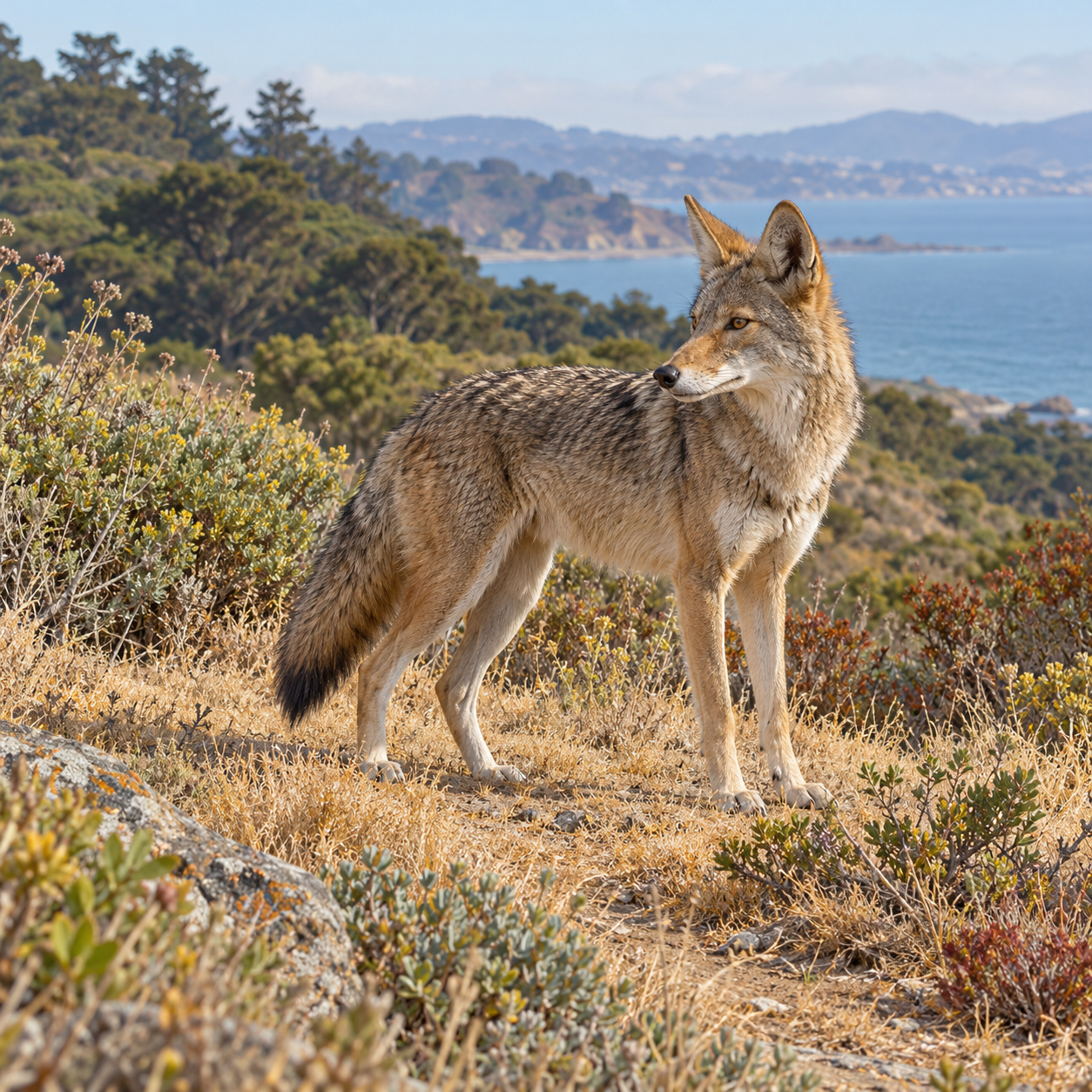
San Francisco — Everyday Connections · researched reference
An urban coyote can make a familiar park feel newly shared, without becoming a symbol of either menace or tameness.
Catalogue details
Scientific name
Canis latrans
Fauna type
Mammal; wild canid
Description
Coyotes are documented in San Francisco and the Presidio. This species reference supports an observed encounter rather than a named animal with a fixed personality. The presence of a coyote does not by itself establish unusual behaviour or a threat.
Appearance
A slender tan-grey canid with pointed ears, a narrow muzzle and a bushy tail commonly carried low. Individual coats and condition vary; the image is a generated natural-history illustration.
Abilities
Moves through varied urban and open habitats and responds closely to sound and movement. Avoid supernatural stealth, human-like motives or guaranteed predictable reactions.
Typical habitat
Open scrub and herbaceous settings are described by NPS; city park sources document urban presence.
Diet
Rodents and other available foods; city sources emphasise a role in rodent control.
Behavior
A scene may show alert observation, pausing or moving away. Keep distance and do not construct a friendly approach as the normal condition of a wild animal. A specific encounter is fictional unless documented.
Social structure
Individual and social behaviour varies; no pack size is fixed for the collection.
Rarity
Documented locally; abundance not assessed.
General notes
Species record, not a named individual. The writer chooses a season, place and observed behaviour; illustration details do not establish a real occurrence.
Writing with this entry
Scene starters
- Two walkers notice the animal at different moments and later disagree about how close it was.
- A character chooses to stop recording rather than move closer for a better image.
Continuity constraints
- No feeding, touching or pursuit is part of the collection scenario.
- Do not turn a brief sighting into proof about a particular den, route or population.
Adaptation notes
Use as part of a shared environment. A named or recurring individual should be a separate local interpretation with an explicit fictional status.
Sensory palette
Observe body shape, movement and sound at a distance; exact calls and encounter conditions are scene choices.
Lifecycle
Age, reproductive condition and season are intentionally unspecified for the representative adult image.
Interaction rule
Human characters observe without assuming familiarity or control.
Connections
- Presidio — Species-level setting connection; no dated occurrence asserted.
Research sources
- Coyote · National Park Service
- Urban Wildlife · San Francisco Recreation and Parks
Use this in your writing
- Use and adapt text and images within original books, scripts and games, including commercial works.
- Use privately for planning and inspiration.
Conditions
- Retain WABF creator and source-version metadata in the local catalogue.
- Do not claim WABF endorsement or exclusive ownership of real-world facts.
- Standalone resale or redistribution of this asset collection is not included in this offer.
Write and Be Found — San Francisco collection, v1
Retain catalogue provenance; published-work credit is encouraged, with placement chosen by the writer.
Source version 1
While writing in Story Forge, open Insert from catalogue, choose Global, and select Use in this story to create your private adaptation.
Browse fauna