Community use
Not rated yet · Used in 0 manuscripts
Counts reflect distinct manuscripts with saved, linked appearances. Private stories contribute only to the total.
Read stories using this source
- No authors have published reader editions featuring this source yet.
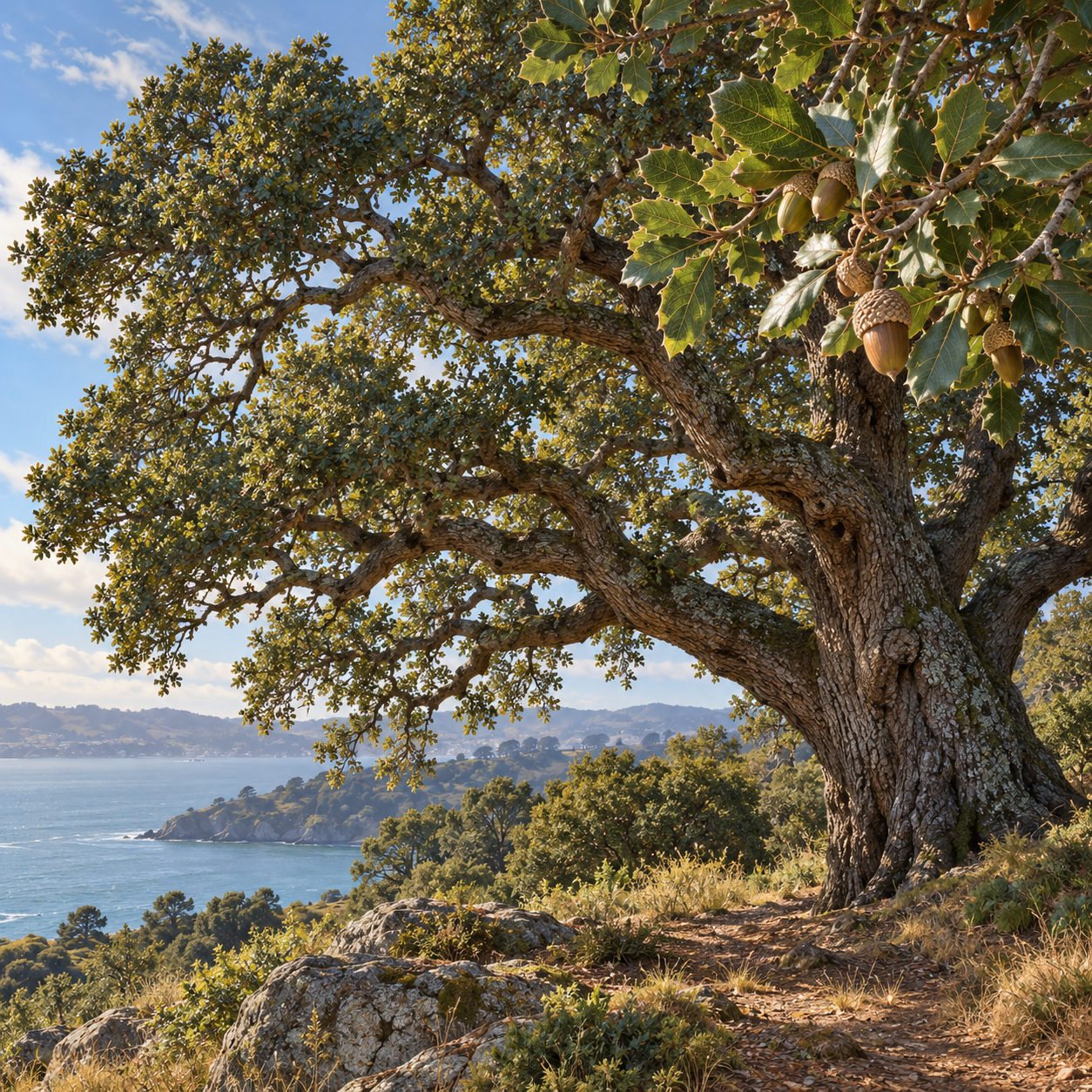
San Francisco — Everyday Connections · researched reference
An evergreen coastal oak offers shade, rough texture and a living timescale larger than a character’s immediate problem.
Catalogue details
Scientific name
Quercus agrifolia
Flora type
Evergreen tree
Description
A researched species reference with optional writing uses. Coast live oak occurs in coastal California and is part of documented Presidio woodland habitat. Its broad form can organise a scene around shade, shelter and the contrast between a slow-growing organism and a hurried conversation.
Appearance
A spreading, irregular crown with dark, rough bark and small leathery leaves whose margins can be curled and spiny. Acorns provide a recognisable detail; the generated image is an interpretation rather than a diagnostic specimen plate.
Typical habitat
Coastal woodland; Presidio sources describe coast-live-oak communities associated with streams or lakes. Do not assume every exposed beach site supports a mature oak.
Rarity
Documented locally; abundance not assessed.
General notes
Separate a species record from any named individual tree introduced in a story. A specific tree’s age, ownership, health and exact position need their own evidence or explicit fictional definition.
Writing with this entry
Scene starters
- Two characters meet beneath a tree that each remembers from a different period of life.
- A recording changes when the observers move from open scrub into woodland shelter.
Continuity constraints
- Do not infer a tree’s age from the illustration.
- No medicinal, edible or harvesting instruction is offered.
Adaptation notes
Use as habitat, recurring place marker or seasonal observation. If a particular tree becomes plot-critical, create a distinct local instance with its own history.
Sensory palette
Dappled light, leaf movement and bark texture are optional scene observations, not evidence of a particular tree.
Lifecycle
A woody perennial; exact age and seasonal state belong to the chosen individual and scene.
Ecological connections
Woodland structure and acorn production can support a scene about habitat; specific animal interactions require observation or further research.
Uses
Shade, setting structure and sensory reference; practical use claims remain outside this profile.
Connections
- Presidio — Local species/habitat reference; not a guaranteed individual sighting.
Research sources
- Coast Live Oak · Golden Gate National Parks Conservancy
- Coastal Live Oak Riparian Forest · National Park Service
Use this in your writing
- Use and adapt text and images within original books, scripts and games, including commercial works.
- Use privately for planning and inspiration.
Conditions
- Retain WABF creator and source-version metadata in the local catalogue.
- Do not claim WABF endorsement or exclusive ownership of real-world facts.
- Standalone resale or redistribution of this asset collection is not included in this offer.
Write and Be Found — San Francisco collection, v1
Retain catalogue provenance; published-work credit is encouraged, with placement chosen by the writer.
Source version 1
While writing in Story Forge, open Insert from catalogue, choose Global, and select Use in this story to create your private adaptation.
Browse flora