Community use
Not rated yet · Used in 0 manuscripts
Counts reflect distinct manuscripts with saved, linked appearances. Private stories contribute only to the total.
Read stories using this source
- No authors have published reader editions featuring this source yet.
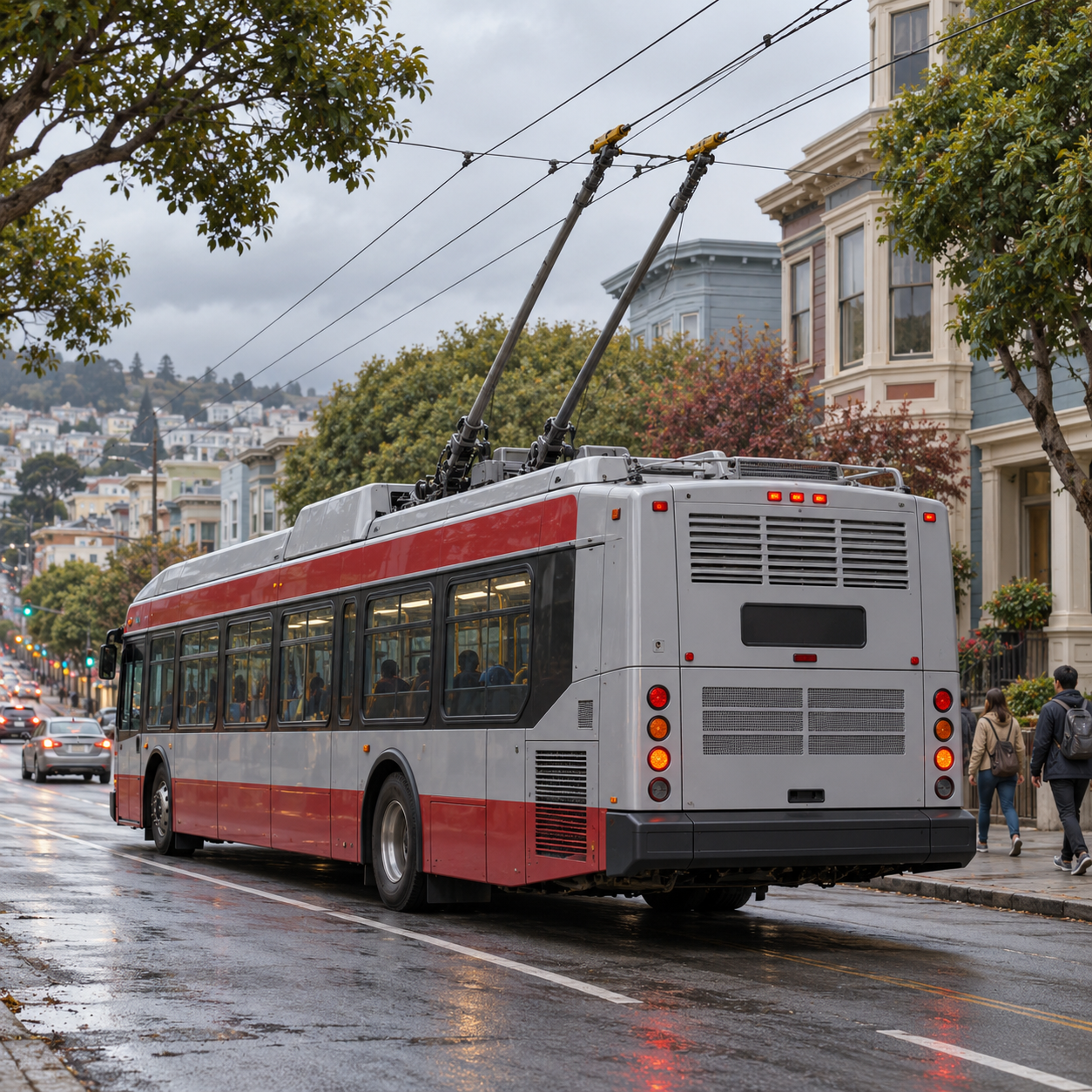
San Francisco — Everyday Connections · researched reference
Two roof-mounted trolley poles connect a rubber-tyred bus to overhead electrical supply.
Catalogue details
Technology type
other
Description
SFMTA describes trolley buses as electrically powered vehicles drawing energy through trolley poles from overhead wires. They run on rubber tyres and are distinct from rail streetcars and underground-cable traction. The illustration uses a generic vehicle without an official livery claim. Operation: The paired overhead contacts provide an electrical circuit for propulsion. The road vehicle remains dependent on its power and route infrastructure, with capabilities varying by vehicle design. Uses: Useful for scenes of everyday movement, an overhead web of wires and the change between a vehicle interior and the street. The vehicle’s operation should be ordinary skilled work rather than unexplained magic. Limits: Do not assume every trolleybus has the same off-wire range, battery system or operating procedure. Specific fleet capability, service changes and safety rules require current technical sources. Context: This is a real technology profile, not a specification of an individual bus or a promise of service on a particular street.
Writing with this entry
Scene starters
- Two characters recognise the same street from its overhead-wire arrangement but disagree about the year.
- A routine journey provides a temporary private conversation in a public place.
Continuity constraints
- Do not assume every trolleybus has the same off-wire range, battery system or operating procedure. Specific fleet capability, service changes and safety rules require current technical sources.
- This is a real technology profile, not a specification of an individual bus or a promise of service on a particular street.
Adaptation notes
Preserve the mechanical distinction when using a contemporary real setting. For alternate history or speculative adaptation, explicitly mark the changed mechanism and its consequences.
Sensory palette
Vehicle motion, mechanical and electrical sound, street surfaces and passenger movement; the image is illustrative rather than a technical diagram.
Operation
The paired overhead contacts provide an electrical circuit for propulsion. The road vehicle remains dependent on its power and route infrastructure, with capabilities varying by vehicle design.
Capabilities
Useful for scenes of everyday movement, an overhead web of wires and the change between a vehicle interior and the street. The vehicle’s operation should be ordinary skilled work rather than unexplained magic.
Requirements and limits
Do not assume every trolleybus has the same off-wire range, battery system or operating procedure. Specific fleet capability, service changes and safety rules require current technical sources.
Availability
This is a real technology profile, not a specification of an individual bus or a promise of service on a particular street.
Costs
Requires capital infrastructure, energy, maintenance and trained labour; no current price or budget is asserted.
Connections
- San Francisco — Real technology reference; current services require verification.
Research sources
- Muni Electric Trolley Buses · San Francisco Municipal Transportation Agency
Use this in your writing
- Use and adapt text and images within original books, scripts and games, including commercial works.
- Use privately for planning and inspiration.
Conditions
- Retain WABF creator and source-version metadata in the local catalogue.
- Do not claim WABF endorsement or exclusive ownership of real-world facts.
- Standalone resale or redistribution of this asset collection is not included in this offer.
Write and Be Found — San Francisco collection, v1
Retain catalogue provenance; published-work credit is encouraged, with placement chosen by the writer.
Source version 1
While writing in Story Forge, open Insert from catalogue, choose Global, and select Use in this story to create your private adaptation.
Browse technologies